Monday, February 15, 2010

Money, Capital and Art

The Appeal of the Walking Man generated heavy email feedback. If this were a commercial site, responding to the “customer demand”, it would have to be renamed Dialectics of Art. But it is not. More to the point, the dialectics of finance is the starting point of making sense of art, so we are on the right track.

This touches upon a point I made to a friend who wanted more about the role of money in influencing art. I said that the role of money is too easy to discern, and gave the example of one Eli Broad, a disagreeable boor who has become the arbiter of art in LA by virtue of having money to throw around.

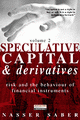
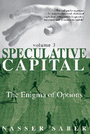
But the role of capital in shaping art is more complex. I discuss the point at some length in Vol. 4 of Speculative Capital. In A Brief Commentary On a Picture I quoted a passage from the manuscript on the importance of the visual. Here is more, by way of proof that Vol. 4 is in the works.
The rise of the visual is a new cultural phenomenon; it has no precedence in either the Eastern or Western cultures, both of which persistently warned against trusting the eye as the instrument of reliable judgment. That appearances are deceiving or that treasure is buried in the ruins is a constant refrain in both cultures.

The Impressionist School in the West rose precisely from the recognition that appearances, as the observer saw them, do not correspond to the reality of the phenomena. The paintings of Cezanne, Degas, and Monet, among many others, reflect this ambiguity of the outside reality that comes into our ken.

Islam forbade painting of faces and discouraged painting in general, so the matter was expressed philosophically – and forcefully and categorically …

But in the land of salesmen, the demand of salesmen – expressing the anxiety of capital in circulation that must be converted from commodity form to money form – destroys long held social beliefs and creates new yardsticks of personal appraisal which gradually become social norms. Those most attuned to the business world carry these demands across culture the way insects pollinate flowers.

The salesman, nota bene, is not wrong. It is just that his concern and focus are different. Cezanne and Rumi were looking for the Truth. The salesman wants to sell. For his narrow but well defined purpose, judging from the appearances will do. Let others worry about the false reflection of reality in the human eye.

As sale assumes an ever more crucial role in the economy and the salesmen increase in number, the reliance on the visual becomes the standard practice and eventually, the social norm. The “visual arts” rises. Color, exaggeration and “flash” that define this art are all stock-in-trade of the salesman. They accentuate the visual and by virtue of being pronounced, create the impression of boldness, confidence and certainty. These, too, are in line with the modus operandi of the salesmen who must at all times show confidence in whatever it is that they are peddling.

In this way, doubt is removed from art. The ambiguity of Impressionist paintings gives way to the in-your-faceness of Warhol’s flashy illustrations. And the content becomes subjugated to the form: the question of what to paint, which is always the more difficult question of painting, is decided by the demands of the form. Hence, the purposefully commercial nature of the visual art’s subjects – a can of a soup, the face of a Hollywood sex symbol – which leaves no room for contemplation. Nay, it discourages contemplation. After all, what is there to contemplate about the packaging of a can of soup? A glance would be sufficient.

This development affects both art and its “consumers”. Consumers conditioned to make rapid judgments, gradually lose their habit – to say nothing of ability – to concentrate and ponder. Thus, the rise of the visual ironically leads to the debasing of the visible real life. This is the well known shrinkage in the “attention span”, whose extremity in the form of attention deficit syndrome is recognized for pathos that it is. Warhol’s perceptive comment about the “15 minutes of fame” captures this shrunken attention span that befalls on the observed, as well as the observer, at the age of the primacy of the visual.
I will return tomorrow with a discussion of a dry legal subject: the Fed’s bailout of AIG.

Sunday, February 7, 2010

Weekend Musings: The Appeal of The Walking Man

The sale of Giacometti’s Walking Man I for a record $104 million was the main “art” news of the past week. The picture of the sculpture made the front page of the major papers, including the Wall Street Journal. Tout le monde was talking about it. So many that I did not know the art appreciation bug had bitten so many.

There was no word on the buyer. Rumors that he was a financier, probably a hedge fund manager, made sense. Only the financiers have that kind of money to throw around. I know of some hedge fund managers who buy masterpieces wholesale.

But lest we forget, for the “hegdies” the acquisition of art is strictly a matter of investing and capital appreciation. Working hand in glove with the gallery owners and auction houses, these merry men of finance accumulate art based on venture capital or takeover model. They either buy the works of relatively unknown artists and then promote them so the works would automatically appreciate – that would be like investing in a start up and taking it public – or do downright acquisition of established companies (artists) in the hope that the ensuing publicity will bring even higher bidders later.

Yet, the expensively acquired piece demands a commentary. What was about it that attracted the attention of a hedge fund manager or a takeover artist? Why this sculpture and not some other?

According to the Wall Street Journal, “the six-foot-tall bronze depicts a wiry man in mid-stride, his right foot jutting forward, his head erect and his arms hanging at his side.”

This description just about sums up the understanding of the art establishment of artworks. It is a description of an auctioneer, of a clerk taking an inventory, which, by the way, is how art is generally taught and interpreted in the West. It is not per se wrong, but irrelevant. It cannot help us understand the work or the secret of its appeal.

Walking Man is an abstract statue. The walker is skeletal, bereft of any particular characteristics. In that regard, he is the universal man. But the height could not be abstracted away. At 6 ft tall, it could not be that of a Chinese, or a Middle Eastern, or even a Latin man. In 1960, when it was created, only the Western man could be represented as being 6 ft tall.

What is about this Western man that attracts our attention?


Look at the pose of the Walking Man and compare it with the poster of a movie that came out the very same year, in 1960.


If you strip away Burt Lancaster’s gun, take away the rifle in his left hand, air brush the woman who is at his feet, strip him of his clothing and eliminate the vengeful expression on his face, you will get close to Giacometti’s Walking Man. In both cases, the upper body is bent forward, indicating a forward motion. And both stare at not what is under their feet but in the horizon.

We readily understand the poster’s message because conveying a succinct message is the function of posters. They do it by creating a context. So we know that Burt Lancaster is hell bent on shedding blood. It is probably revenge; surely the other guy must have started it. Pursuing that righteous fury, he will not heed the cries of the weak Audrey Hepburn trying to stop him. A man’s gotta do what a man’s gotta do. In this way, the poster defines the context of the picture.

Returning to construct the context of the Walking Man, we have several problems.

One is the matter of bent right leg. Lancaster’s forward leg is bent because he needs support, as he is dragging Audrey Hepburn.

The Walking Man’s forward leg is not bent, indicating that he is not carrying any load which he indeed does not. But then why bend forward? No one walks like that, certainly not a slender figure with long strides.

Then, there is the matter of hands and arms. When we walk, the left (right) arm and right (leg) leg move forward in unison. Such synchrony is dictated by gravity and the laws of dynamics. But the Walking Man's arms do not follow this rule. They are hanging beside him with a little forward lean. This posture is in contrivance of the laws of dynamics, which is why we feel the statue's pose is somehow not right.

Why would anyone assume such a posture in “mid stride”, as the Wall Street Journal describes the pose?

The answer is that no one would; maybe a robot, or an automaton, but our subject is a man.

The only way to explain the suspension of the laws of dynamics is to realize that the laws do not apply because there is no motion. The Walking Man is not walking at all. He has just stopped, almost suddenly, because he has seen something on the horizon. His look is without any expression, almost as if he were a cretin, but what is on the horizon is sufficiently worrisome to make even cretins pause in the mid stride and take note.

The name is not a tease. The sculpture we see is that of a walking man. Any other name would be incorrect. It is just that we are seeing a walking man at the instant of coming to a halt.

The Walking Man is Hank Paulson realizing that “the world is falling apart” and rushing to call his wife. He is Dick Fuld on the eve of Sunday, September 14, 2008, realzing that Lehman was doomed. He is Alan Swchartz, learning suddenly that cash hemorrhaging of Bear Stearns cannot be stopped. He is Alan Greenspan, realizing that everything he knew was wrong. And Sandy Weill, half-understanding that all was vanity and for naught.

The Walking Man is the cocksure man of finance. You will see him confidently talking in cocktail parties, with his mistress, as the special guest in MBA seminars, charity fund raisers and the Congressional hearings. He puts on a brave front day and night. But he knows that one day, something will appear on the horizon that will make him stop cold.

The Walking Man speaks to that uncertainty. That is its appeal to the hollow men of modern finance.

Wednesday, February 3, 2010

The [Permissible] Boundaries of Bank Regulation

If you have been following current events, you are familiar with President Obama’s plan to “take on” banks. His plan, inspired by Paul Volker, calls for, among other things, the banning of proprietary trading by banks.

If you have been following this blog, you know that proprietary or prop trading is arbitrage trading – taking simultaneous long and short positions in two “equivalent” trades. That is the modus operandi of speculative capital which still, two years into a protracted crisis, dominates the markets.

The Theory of Speculative Capital posits that speculative capital would not, short of being forcefully subdued, accept any restraints or limitations on itself. From Vol. 1:
Speculative capital abhors regulation. Regulations interfere with the cross-market arbitrage that is its lifeline. If speculative capital cannot freely operate, it cannot generate profits and must cease to exist. The opposition of speculative capital to regulation is thus not a matter of some technical or tactical disagreement but a question of life and death.
So if my Theory of Speculative Capital is correct, then the President’s bank regulation plans, at least the part that deals with prop trading, should be dead on arrival, no matter what. From today’s New York Times:
The chairman of the Senate Banking Committee warned on Tuesday that the Obama administration’s new proposals to rein in Wall Street firms ran the risk of derailing months of delicate negotiations over overhauling financial regulations.“It’s not a movable feast,” the chairman, Christopher J. Dodd, told Paul A. Volcker, … who has become an influential outside adviser to President Obama, [adding] that the administration was “getting precariously close” to excessive ambition for the legislation.
There you have it.

Not to underestimate Congress’s ability to neuter any legislative proposal on cue no matter how ironclad the theory behind it, but the administration’s proposal, what President Obama called “Volker rule”, has a theoretical Achilles’ heel that makes it vulnerable to attack. The problem is the definition of prop trading. According to the Times, in answer to criticism that his rule was too vague, Volker said:
”Every banker I speak with knows very well what proprietary trading means and implies.” For example, he said, a pattern of exceptionally large gains and losses over time in a Wall Street firm’s trading book should “raise an examiner’s eyebrows.”
Sorry Mr. Volker, but large gains and losses or the intuitive recognition of bankers cannot be the basis of regulation; it must be made of sterner stuff.

Volker’s problem is theory. He cannot define prop trading because prop trading is arbitrage trading. And speculative and potentially ruinous arbitrage is, after the trade is made, indistinguishable from the “legitimate and conservative” hedging. That was my discovery in Vol. 1 that led to the Theory of Speculative Capital:
The most important point in the rise of arbitrage trading is that the practice develops logically from hedging and, on paper, is indistinguishable from it. What logically separates them is the purpose of each act which translates itself to the sequence of execution of trades. When done sequentially, the act is defensive hedging. When done simultaneously, it is aggressive arbitrage. Otherwise, the transformation of one to the other is seamless.
If you know Volker’s address, send him a copy of Vol. 1.

Monday, February 1, 2010

Hank Paulson On the Brink

A while back I criticized the book by a financial correspondent of the New York Times about the financial crisis as gossipy, trashy and not at all informative. Then, in today’s Wall Street Journal, I read an excerpt from Hank Paulson’s new book, On the Brink.

There is no doubt: on the evidence of his writing, the man is a cretin. In the half-page excerpt, he describes nonsensical and random details that would alarm a mad painter: leaving the Waldorf=Astoria Hotel early in the morning, speeding down a deserted Park Ave, getting to the Fed before 7am, riding the elevator to the 13th floor, wondering whether or not to take sleeping pills that were given to him in Washington D.C. (Being a Christian Scientist, he decides against it).

These details might or might not have been added for drama. But these are the things that he remembers precisely because he does not understand the crisis that is unfolding around him. He knows he is grossly out of his depth, so he does not dare/bother to pause, think, and contemplate. He merely moves – jumps really, like a headless chicken – from one scene of the crisis to the next. Naturally, then, after two days he is exhausted:
All weekend I’d been wearing my crisis armor, but now I felt my guard slipping.
And what does a former CEO of Goldman Sachs, now the Treasury secretary, do under these conditions?
I knew I had to call my wife, but I didn't want to do it from the landline in my office because other people were there.

”What if the system collapses?” I asked her. “Everybody is looking to me, and I don't have the answer. I am really scared.” I asked her to pray for me, and for the country, and to help me cope with this sudden onslaught of fear.
His wife, just back from the church, immediately quotes from the Second Book of Timothy, verse 1.7 which says that God “hath not given us the spirit of fear but ... of a sound mind”.

The objective conditions produced by this crisis enabled me to sharpen the Theory of Speculative Capital. The unintended humor produced by the various players in the crisis provided much needed comic relief after long hours of work. How many times, in the middle of the night, reading a seemingly serious piece on the crisis, have I burst out laughing!

Wearing one down and energizing him: that, too, I suppose, is a dialectical characteristic of the crisis.

Monday, January 25, 2010

The Driver of Social Change – (Epilogue)

Why did I choose an obscure dispute over the regulation of derivatives to expound on the macro themes of social change and public alienation?

The reason is that the dispute goes to the heart of the matter. It is the heart of the matter – the definition of finance, the dialectics inherent in a dispute (that is pregnant with new developments), the abstract nature of the argument (that goes over the collective head of the hoi polloi) and the uncompromising position of the parties (who know what the stakes are) – are all there.

Let us begin with the definition, which is a highlighting of relations. The definition sets the direction of the investigation by establishing the investigator's point of view, his angle of vision to reality. If it is set right, things will fall into place.

Here is a finance professor writing to the editor of the Financial Times to volunteer his unsolicited 2 cents about the crisis :

First, “finance” must not be considered as one homogeneous discipline. The traditional finance (asset management, corporate and international finance) did not create the crisis, but the mathematical finance/economics that invented the structured products certainly played a part because they feed the financial markets’ appetite for generating excess profits based on non-existing assets.
Finance not a homogeneous discipline!

Finance concerned with asset management and corporate finance. (Thanks, Paul Samuelson!)

Mathematical finance “inventing” structured products!

With this appalling insubstantiality as the starting point, our professor could not go far – or at all.

Finance is the discipline of studying finance capital. Finance capital is capital in circulation that is evolved to the point of subjugating the industrial capital, the capital in the realm of production.

Capital in circulation – historically its two dominant forms were merchants’ capital and bank capital – is necessary for the realization of the value of products; a product must be sold for the profit in it to be realized, hence the critical role of say, merchants’ capital, that delivers the products from the producer to consumers. In that regard, while it logically plays a subordinate role to the industrial capital, its existence is nevertheless necessary, because without the conversion of commodities into money, the production cycle would cease.

From this historical position of being a “humble servant” of the industrial capital, capital in circulation evolves to the point of dominating the tempo of the entire production process, including that of industrial capital.

In the previous volumes of Speculative Capital, I touched upon the nature of this transformation. In the upcoming Vols. 4 and 5, I will delve into the subject in further detail. But two words that I just used need elaborating.

One is “subjugate”. What does the word mean when applied to the relation of two forms of capital?

For the answer, consider the car market in the West, especially in the U.S. Whilst previously cars were purchased, they are now leased, typically with 3-5 year terms. The change was brought about, driven and dictated by the funding exigencies of the finance capital that resides, among other places, in the financial subsidiaries of auto manufacturers.

The design engineers, the marketing executives, the raw material producers and the parts suppliers are then forced to react to the fact that the average life of the car on the road is reduced to the terms of the lease. That is the dominance of production by finance capital.

Or take a case from the aviation. Two recent events, the test flight of Airbus A380 and Boeing 787 made the news. While the A380 is a totally new plane with new concepts, the 787 is a rehash of the existing lines. Still, the plane was more than 2 years behind in the delivery schedule and experienced considerable design difficulties. Why did Boeing engineers who invented the mass production of the commercial aircraft have such a hard time with the latest model? From The Financial Times of February 27, 2004:
Boeing has left it too late to catch up with Airbus in modernizing its commercial aircraft range because shareholder “short-termism” would not allow the scale of investment needed, the head of BAE Systems claimed yesterday … The failure to renew its product range resulted in Boeing being overtaken by Airbus in terms of deliveries for the first time in 2003 … Sir Richard Evans, the outgoing chairman of BAE … estimated Boeing would need to spend between $40bn and $50bn over the next 10 to 15 years to “match” Airbus’s product range.
Note that the culprit is not financing, in the sense of the availability of capital, but the speed of the turnover of finance capital that has a tendency to increase, leading to the “short-termism” of the executives.

The other word is “evolve”, as in “capital in circulation evolves to the point of dominating the tempo of the entire production process”. The word has a historical connotation. It includes expansion and growth – both, quantitatively in size, and qualitatively in form.

For the size, it will suffice to quote from the finance professors who regularly cite that the size of “finance" as a percentage of the GDP has doubled from about 4% in the mid 1970s to about 8%. In terms of form, there is of course the rise of speculative capital, the latest and most aggressive form of finance capital which reaps profit from volatility. From Vol. 2:
Derivatives are the functional form that speculative capital assumes in the market. This form is fundamentally a bet. But like the bodies of the damned in the Inferno whose deformity corresponds to the sort of sin they have committed, the particular composition of each derivative corresponds to the sort of arbitrage opportunity that speculative capital intends to exploit. Arbitrage opportunities are many and varied; hence the confusing array of derivatives.
It was the expansion of speculative capital, being pushed by one side and resisted by the other, that took the form of the fight over the regulation of derivatives.

The U.S. side demanded constant marking-to-market, a practice that presupposes trading. That is the realm of finance capital.

The “end users”, all industrial companies representing industrial capital, wanted to prevent finance capital from getting a foothold within their accounting system, and eventually, their production cycle.

For the time being, the two sides being approximately equal in political power, the matter ended in a draw. The two sides agreed to disagree. But we have not heard the last of this dispute.

What I discovered theoretically about speculative capital, speculative capital and its agent know instinctively. From the New York Times of April 27, '08, describing a meeting in which then Treasury secretary Rubin got uncharacteristically angry in a meeting in which he was trying to block the regulation of derivatives.

But on at least one occasion, Mr. Rubin lined up with Mr. Summers and Mr. Greenspan to block a 1998 proposal by the Commodity Futures Trading Commission that would have effectively moved many derivatives out of the shadows and made them subject to regulation ... At an April 21, 1998, meeting with Brooksley Born, the chairwoman of the commodities commission, Mr. Rubin made no secret of his feelings about her proposal. “It was controlled anger. He was very tough,” Mr. Greenberger [then director of trading and markets at the CFTC] recalls. “I was at several meetings with him, and I’ve never seen him like that before or after”.
From the Nice Jewish Boy to a bully in a few seconds! One more word from Brooksley Born and Bob Rubin would have pulled a knife on her!

Why this uncharacteristic anger? Why the Treasury secretary of the U.S. who, by all accounts is a mild mannered, almost shy, individual, gets all worked up over something like the regulation of derivatives?

The answer is that he is not the Treasury secretary in the institutional sense of the word, with all the duties and obligations of the office that go with it, but an ex-Goldman FX arb trader occupying the office. He gets angry because he instinctively knows that the proposed regulation would get in the way of arbs making money.

Look at this unbelievable passage, unbelievable because what a single individual is allowed to do under the auspices of the U.S. government, from a laudatory article in the New York Times that I quoted in Vol. 1:
Then, when the dollar had fallen off the front pages and the market’s attention was elsewhere, they [Rubin and Summers] ambushed the currency speculators, ordering the Treasury to buy dollars. The idea was to sow so much uncertainty about the Treasury’s tactics that no big speculators or hedge funds would risk being caught with a huge position in yen.
I commented there:
So the Treasury Secretary of the United States fixes the exchange rate of the dollar against the yen by sowing uncertainty about their exchange rate!
A palan dooz is allowed to run the U.S. Treasury Department like a hedge fund – and then go further still:
His [Rubin’s] first move was to impose an ironclad rule that he would be the only one in the Administration even to talk about the dollar, the loquacious president included … Mr. Rubin had a free hand in fighting the dollar war; the President almost never got involved.
The president of the U.S. is forbidden by his Treasury secretary from talking about the U.S. currency.

We now see the larger issue behind the regulation of the derivatives. To facilitate its movement, finance capital changes the laws to its favor. If the laws, including those of the sovereign nations, stand in its way, they have to go. Hence, the “globalization”, a term that is void of national and political connotation precisely because speculative capital deems them irrelevant.

Because the laws enabling, empowering and propelling speculative capital are enacted at a macro, almost abstract level, they appear as a “given”, like the laws of nature, with the result that they remain outside the political discussions and agenda; think of the Fed’s “independence”. In this way, policy making become removed from the hands of policy makers. Policy is removed from politics.

Under these conditions, the difference between one politician and the next becomes the color of their skin, and not the content of their policy – or even character.

Such changes are far from natural. In fact, they are the elements of the most extreme and disruptive form of social engineering. But because the dynamics of the process is hidden from the people, they feel powerless to bring about any change. They become passive, alienated, superstitious and angry.

All the while, Prof. Becker, who dislikes social engineering very much, will have nary a word on these subjects.

Sunday, January 17, 2010

The Driver of Social Change (2 of 2)

This past year I spent a grim November in Zurich. Grim were the politics; Zurich is a beautiful city and I have dear friends there.

The talk of the town was the national referendum to ban the construction of minarets in Switzerland. The anti-minaret poster which itself became the subject of controversy was everywhere. It showed a woman in burka next to a cluster of minarets that looked like missiles, all juxtaposed over a Swiss flag. The message was that backwards Islam will destroy Switzerland.

On November 29, the measure passed with 57% of votes.

In the past couple of years, we have seen the variations of this theme played across Europe, most recently in France, where wearing burka was banned in school. The President of the Republic himself took a very public stand against this “symbol of oppression”.

But I couldn't help noticing the changing narrative in Switzerland. Whilst previously the talk had been around the Muslim hordes invading the idyllic European landscape, the anti-minaret campaign focused on the “power” of Islam; hence the modern “missiles”. The general secretary of the Swiss People’s Party which had sponsored the anti-minaret measure said that its passage was “a vote against minarets as symbols of Islamic power”.

The claim seems absurd. Any passer-by could readily see that Muslims have no political influence or say in Switzerland – or anywhere in Western Europe. A Tissin butcher’s social and political influence will trump theirs any time. To which Muslim power then was the general secretary of SVP referring?

***

The same November, another dispute reached its climax. This one could not have been more removed from the minaret controversy in terms of public awareness, sentiment and reaction. Few people in Switzerland and Europe heard about it. Even if they had, a question about the issue would have drawn a blank stare, because it involved the regulation of derivatives.

The U.S., with the support of the U.K., wanted to move the trading of the over-the-counter derivatives to the exchanges. The claim was that such a move would reduce the counterparty risk and add to the transparency.

The Europeans, headed by France and Germany, opposed the move. They claimed that exchange trading would add to the costs by subjecting the trades to margin calls. The Financial Times reported the split:
Europe’s largest companies have accused the US of being “adamantly unwilling” to relax proposed reforms of the over-the-counter derivatives markets ... The comments made by the European Association of Corporate Treasurers (EACT), raise the possibility that Europe and US may go their own ways in implementing reforms of the OTC derivatives market ... The administration of Barack Obama in the US and the European Commission argue this is needed to reduce so-called counterparty risk in the financial system since clearing houses ensure that transactions are completed even if one party to a trade defaults.

Companies counter that they would be unfairly penalised if such reforms became law because the laws would oblige them to set aside extra cash – margin – to guarantee those trades ... Richard Raeburn, chairman of the EACT, whose members include Volkswagen, Siemens and Rolls Royce, said his body would not hesitate to “look to the European Commission and Parliament to be prepared to take a more considered and pragmatic approach” than that of the US. Mr Raeburn said that if this resulted in “divergence from the US, so be it”.
First, take note of the parties to the dispute. On one side is the “Obama administration”, i.e., the U.S. government; on the other, Volkswagen, Siemens and Rolls Royce, backed by EACT and then, the European Commission and European Parliament. But lest you think this is a U.S. vs Europe issue – no issue ever is strictly Europe vs. U.S. – here is a subsequent paragraph from the same article:
In the US, the issue of company exemptions from OTC derivatives reform is likely to be raised today at a hearing of the Senate’s agriculture committee.

The Coalition for Derivatives End-Users, a recently formed lobby group representing 180 US companies including Apple, Intel, Caterpillar and 3M recently wrote to House speaker Nancy Pelosi urging lawmakers to “preserve the ability of companies to manage their individual risk exposures by ensuring access to reasonably priced and customised over-the-counter derivatives”.
So, in addition to Volkswagen, Siemens and Rolls Royce in Europe, Apple, Intel, Caterpillar and 3M in the U.S. are also against the “reform”; they are against the derivatives being traded in the exchanges.

These are all industrial companies. If you read their letter to members of Congress, you will not find Goldman Sachs, Morgan Stanley, Citigroup or Bank of America among the petitioners. This latter group is represented by the “Obama administration”. What we have here is a quarrel between the industrial and finance capital, each side jockeying to place itself in the most advantageous position within the system. And no one is budging; inconsistent accounting treatment of the derivatives in the U.S. and Europe? “So be it”.

In the U.S., finance capital reigns. The industrial capital can only appeal to Congress. Finance capital owns it. So the “financial reform” legislation will force trading of OTC derivatives in whole or in part into the exchanges.

In Europe, the European Commission is also under the spell of finance capital. The industrial companies know that; hence their threat to take the matter to European Parliament, which they control and has the power to strip the European Commissioners of their authority.

Where could the European industrial companies go if there was no EU? The answer is, nowhere; without the EU mechanism they would have had no place to go to protect their interests.

By following the obscure and technical matter of the regulation of the derivatives, we thus arrive at the reason for the creation of the European Union, its raison d’etre.

EU is created for the explicit purpose of advancing the interests of the “European” capital, as a counterweight to the “Anglo-Saxon” capital in the U.S. and U.K. “Existence of a functioning market economy and the capacity to cope with competitive pressure and market forces within the Union” is the main criterion of membership.

Within the Union, the industrial and finance capital occupy relatively equal positions of power. They have a peaceful coexistence of sorts but tension surfaces every now and then when the interests of one side are too clearly threatened. (Hence the ambivalence of finance capital-dominated U.K. to the Union, despite the geographic proximity and cultural links.)

The remoteness of the derivatives dispute is symptomatic of the “macro”, almost abstract, level in which the various treaties, directives, rules, laws and regulations of the Union are implemented. These measures affect every area of life in the Union, including agriculture, competition, economic and monetary affairs, education, environment, external trade, public health, institutional affairs, research and taxation. Yet, the population remains woefully ignorant about them. What is more, they have had no say or choice in their implementation. The Constitution of the Union which codified these far reaching changes – it is referred to as the “Lisbon Treaty” to make it sound dull and uninteresting – was imposed from the top.

In countries where it could be adopted through the political machinery, the governments quietly obliged. In countries where a direct vote by the population was required, a “Yes” vote was called for. When the vote turned out to be “No”, it was promptly ignored. “We cannot say that the treaty is dead” said the European Commission President after the French “No” vote, although, in theory, the treaty had to be dead because a unanimous approval was a condition for its passage.

The same thing happened in Holland and, later, in Ireland, when the “No” vote was dismissed as the mindless act of uncouth peasants who did not know what was good for them. Capital will simply not take a “No” for an answer when the course of its future development is at stake.
When the French and the Dutch voted against the constitutional treaty in May and June 2005, the document reappeared as a “mini-treaty”, longer than the original, and was ratified by governments without recourse to a referendum. Many countries have reneged on promises they made to their electorates about a referendum.
The Irish had to vote again until they got it right. As Margaret Thatcher put it, “there is no alternative”.

The European citizenry cannot articulate these developments, but they perceive the contempt that they signify. They look for an alternative, a total Other, and some of them find Islam.

Switzerland is not a part of the EU, but fits this description to a tee. So in the most unlikely places in Zurich, you see businessmen in the tight fitting dark European suite with a kaffieh wrapped around his neck and suddenly you understand the reference to the power of Islam and concerns about it. The concerns are neither due to minarets nor the Turkish emigrants manning fast food stands, but the Swiss, repelled by the system that despite protestations to the contrary, have begun to suspect, no longer reflects their concerns.

I will return with the epilogue.

Wednesday, January 6, 2010

The Role of Businessmen In Shaping Events

On Sunday, The New York Times had a long article on Sandy Weill. It was the vintage Times P.R. piece, including hyped style to give the story a Homeric or Shakespearean dimension. The man who rose from a humble childhood to build Citi to a powerhouse had it all, got humiliated, now is sad, hurt, lonely, unwanted; “There is no creature loves me” stuff. He is still “baronially wealthy” (of course); he wants to be remembered for his charity work.

Sandy Weill is an easy mark for mockery. But we should resist the temptation, first, because his vulnerability makes mocking him improper, almost obscene, like an intellectual equivalent of dwarf tossing. More importantly, jesting distracts us from the larger question of the role of businessmen in shaping the events which his story can help us explore. The issue is defined in the contrasting views expressed in the article:
Though he [Weill] was once viewed as a brilliant deal-maker, some critics now cast him as the architect of a shoddily constructed, unmanageable financial supermarket … “The dream, the mirage has always been the global supermarket, but the reality is that it was a shopping mall,” says [a critic]…

Mr. Weill vigorously defends his record, rebutting critics who say that Citi was an unstable creation. [A friend] who worked with Mr. Weill on his autobiography, said that Citi’s problem wasn’t that it was unmanageable, but that it lacked enough good managers… “Had he picked a different successor things could have turned out very differently,” [he said].
Is the friend right? Was it a matter of one mistake – choosing a wrong successor – which brought Citi to its knees? Or was the fall pre-ordained, the seeds of the failure planted by what had come before?

The premise that with a better person at the helm, things could have turned out differently is intuitively appealing because it is within the realm of possibilities. We could have won last month's lottery if we had chosen the winning numbers, you know.

But the analogy is false. The lottery example is from the inanimate world where relations are fixed and therefore, have no context; they are memoryless, in the jargon of mathematicians, meaning that what happened in the past has no bearing on the future.

The fate of Citi after Weill is in the realm of finance, which is the realm of social (because value is a social concept). In this realm, all actions have their roots in the past. Nothing exists out of context, including the character of personalities.

What was the context, the milieu, in which Sandy Weill chose his successor?

The article had all the clues for the looking:
“This is my final annual meeting as chairman,” says Sandy Weill, standing near the window of his office, peering at a grainy photograph of him and his wife on stage at Carnegie Hall more than three years ago. They are smiling broadly, and behind them is a packed house of cheering Citigroup shareholders. A huge banner dangling from the balcony reads “Thank You Sandy.” On that day, April 18, 2006, Citi’s share price was $48.48.
Like the witches in the opening scene of Macbeth, the stock price in the opening paragraph of the story sets the stage for what is to come. But unlike the witches, the stock price in the Sandy Weill story does not go away. It hovers over and drives the narrative.
Mr. Weill firmly contends that what he built at Citigroup created huge value for employees and shareholders.
Even after retirement:
Mr. Weill continued to track it [stock price] closely. “He was watching every movement of the stock; he was reading everything,” recalls Mike Masin, a longtime friend and a former chief operating officer of Citigroup. “We have had conversations about the fact that he has to make Citi less a part of his life.”
Mr. Masin does not know his longtime friend well enough. It was not Citi with which Sandy Weill was obsessed. It was money. The bank and its stock were mere proxies towards which the obsession was channeled. This, Sandy Weill tells us himself, though, without realizing:
He [Weill] has raised $950 million for Weill Cornell’s $1.3 billion fund-raising campaign and recently put together a $110 million bond offering for Carnegie Hall. “It was like being back in business again,” he says. “I get the same kind of kick by getting somebody to make a major charitable contribution. It’s the same kind of adrenaline rush.”
Functionally, fund raising on behalf of charities and running a financial conglomerate are two entirely different things. But they have one commonality, namely, money. It is money which gives Sandy Weill a “kick”, “an adrenaline rush”, just “like being back in the business again”. For Freud, money was “laughing gas”. For Sandy Weill, it is crack. The man is the embodiment, the personification, of the “rational man” of economic textbooks who always “prefers more to less”. When the subject of the desire is a commodity, as in the old economic textbooks, there is a limit to the desire. Hence, the “decreasing marginal utility” concept: the second Rolls Royce would be slightly less satisfactory than the first one. And there is a limit to the number of hamburgers one could eat. (Again, economics textbooks example).

In finance, the subject is money. Money has no decreasing marginal utility. The second dollar is as valuable as the first, perhaps more. So the pursuit of money does not – cannot – stop. In the narrative of Weill's life story, money has the same role that sex has in “120 Days of Sodom”.

But how do you constantly get more money? How could you make the stock price constantly go up – deliver “value to the shareholder”? A medium size financial company's normal return would not do the trick. The only way to go is through acquisition.

Enter Sandy Weill as a “brilliant deal maker”. The P.R. angle aside, the Times description is accurate. The man created a financial behemoth with 200,000 workers and almost $2 trillion in assets. That required buying, appending, acquiring with a religious zeal. Such deals are complicated, time-consuming, exhausting. Imagine the amount time of money spent on lobbying for the repeal of a major piece of legislation such as Glass-Steagall, which made the merger of Travelers and Citibank possible.
On another wall [in Weill’s office] hangs a hunk of wood — at least 4 feet wide — etched with his portrait and the words “The Shatterer of Glass-Steagall.” The memento is a reference to the repeal in 1999 of Depression-era legislation; the repeal overturned core financial regulations, allowed for the creation of Citi and helped feed the Wall Street boom.
Weill had to be good at what he did. He could easily be the best deal-maker alive – second best, if you counted the dead.

How does a man like Weill choose a successor?

The successor had to continue the legacy, he had to keep the flame alive. That was the requirement which trumped all other considerations. The successor could not let the shareholders, Weill himself the most prominent among them, down.
He no longer had any official position at Citigroup, having retired as chief executive in 2003 and as chairman in 2006. But he was still hugely invested in the company. He owned more than 16 million shares in 2006.
Look. Sandy has just retired. The stock closed at $48.48. There are these structured finance instruments – lawyers call them special purpose vehicles -- through which you could borrow at under 3% and lend through the CDOs to mortgage holders at 6%. It is an incredibly profitable business, guaranteed to boost the stock price. What do you say to that Mr. New CEO?

No successor to Weill could ignore or oppose that pitch, not with the constant pressure to boost the stock price. The choice had to be a Chuck Prince.

And so it was. Prince’s much ridiculed comments about the CDO market that, “When the music stops, in terms of liquidity, things will be complicated. But as long as the music is playing, you’ve got to get up and dance. We’re still dancing” was the accurate description of his mission statement. Citi stock went from $48.48 to $55 and change before the crash came.

What about a good “manager”, a good “executive”, of the kind who could manage the disparate business lines that Weill had accumulated under the Citi umbrella? That was impossible. Weill could not know such person. He would not know a good manager if one kicked him in the teeth. A good manager would not get past Weill's first secretary. He would not get pass Weill’s doorman.

That is because such “manager” would be a relic of the past, an organizational man from the 50's. The idealized manager, of the kind wished for in the Times article belongs a more serene time, when the business tempo was “calm” because it was set by the predictable turnover of the industrial capital. So the GM’s five disparate car divisions – Pontiac, Buick, Cadillac, Chevrolet, Oldsmobile – plus its military wings and other divisions – far more diverse than anything Sandy Weill could put together – could be successfully managed.

At the age of speculative capital, which generates profit not from production but from price volatility, there can be no managers in the old mold. They have to be replaced by the deal-makers of Weill’s stripes. Witness how fast John Reed was gotten rid of. I am not sure what his managerial credentials were, but as an M.I.T. trained engineer, he was not a deal maker. And that was sufficient for his undoing:
In November, Mr. Weill’s former co-C.E.O. at Citi, John Reed, told Bloomberg News that he was sorry for his role in helping to end Glass-Steagall. When asked about Mr. Reed’s apology, Mr. Weill says: “I don’t agree at all.” Such differences, he says, were “part of our problem.”
Sandy Weill no doubt wonders what this fool Reed could be thinking, regretting the repeal of a law that stood in the way of making more money.

Could Sandy Weill have picked another person, a more “competent” manager?

The answer is No, he could not have. He could have, only under conditions that Rumi, as usual having the last word, said an impossible would be possible:

If it were to be possible for the life to go on without you, then the world had to be upside down.

For Sandy Weill to have picked a different successor, the deregulation must not have happened, Glass-Steagall must have remained intact, Citi must have not have become a behemoth, the CDO market must not have been created which means, ultimately, that Sandy Weill himself must not have existed.

So, you see, Mr. Weill, everything was, in a sense, pre-ordained. For the cause of what you see around yourself, may I suggest consulting a mirror?

But that in no way means that I blame you for what happened. I know that like Oedipus, your deeds were inflicted upon you rather than committed by you. And unlike Oedipus, you managed to put away a nice little something from which you could enrich New York’s cultural institutions. That’s the stuff philanthropies are made of!

Is that the fate of all men, then, ultimately being crushed by events, hoping at best to be remembered by their charitable givings, like a society lady?

The answer is, no. Historical personalities fare better because they know the direction of the movement of history and align themselves with it. At times, they even move ahead of the events. The awareness and the will to act on it distinguish the historical figures from the businessmen.

The subject of this blog is precisely the march of history as it manifests itself in the realm of finance.