Friday, August 26, 2011

What Is Behind the Critical Shortage of Prescription Drugs?

Today, the critical shortage of prescription drugs reached the editorial page of the New York Times. Under the heading The Shortage of Vital Drugs, the paper said:
A widespread shortage of prescription drugs is hampering the treatment of patients who have cancer, severe infections and other serious illnesses.

The Food and Drug Administration says that some 180 medically important drugs have been in short supply, many of which are older, cheaper generic drugs administered by injection that have to be kept sterile from contamination.

A survey of 820 hospitals in June … found that almost all of them had experienced a shortage of at least one drug in the previous six months … As a result, more than 80 percent of the hospitals delayed needed treatments, almost 70 percent gave patients a less effective drug, and almost 80 percent rationed or restricted access to drugs.
The cause of this shortage? According to the editorial:
Nobody is sure just what is causing the shortages ... But several factors are likely to be involved: contamination problems at some manufacturing plants, forcing unexpected production shutdowns; difficulties in getting pharmaceutical ingredients from suppliers, especially those abroad; reluctance to invest in production-line improvement for low-profit generics when high-priced brand-name drugs bring in far higher profits. Sweeping consolidation in the generic drug industry means that fewer companies are left in that market to make up for a shortage.
The Times has become a trashy paper, more in the league of The New York Post than its previous self. Its stories are old, the opinions in its pages downright embarrassing. That is why I rarely quote it now.

Here, it blames “contamination” and the difficulties with the supply lines. The drug companies in question are some of the largest, most advanced industrial corporations in the world. They are the “Big Pharma”, some with over a century of experience in drug manufacturing; we are not talking about the chicken processing plants in Alabama and Georgia. The idea that they will allow contamination or suppliers to impact their output is laughable.

More than 3 months ago, the Financial Times had covered the same story in a greater depth. On May 4, in a news story titled Drug takeovers spark shortages it said:
Pricing pressures and takeovers in the US pharmaceuticals sectors have contributed to record medicine shortage and could put lives at risk, sparking calls for wide-ranging reform.

The American Society of Health-System Pharmacists said last year its members could not obtain an unprecedented 211 prescription drugs through the usual channels ...

Cynthia Reilly, director of the ASHP’s practice development division, said: “There has been a lot of consolidation among manufacturers, with fewer producing any given product, and more quality inspection by regulators. “For older, off-patent drugs, some companies are disengaging because it’s not where the profit is.”
Cynthia Reilly is barely touching upon the subject. The background of the drug shortage, in a nutshell, is that the century-old business model of pharmaceutical companies – doing research and bringing new drugs to market under the protection of the patent law – is no longer working. The problem is structural.

In the 1980s, the Big Three auto companies also faced a structural problem: they could no longer afford the social function of supporting their retirees. At one point, GM claimed $1,100 in the price of each car was earmarked for retirees' pension and insurance. With a nod from the company, the stories spread about GM being a retirement fund that also happened to make cars. In the face of stiff competition from then Japanese car makers, that could not be done. The rest is history, with bankruptcies, pension losses and layoffs.

The problem of the big pharma is likewise structural albeit of a different nature. “Structural” is the key word, though. It means that there is no cure. The business model is dying and, naturally, the vultures have descended on the scene.

Here is one, as per The New York Times of January 26, 2005, under the heading Making a Fortune by Wagering That Drug Prices Tend to Rise. As you can see, the problem has been in the making for some time.

Over the last 20 years, the packing and shipping of drugs evolved into a game of arbitrage, called speculative buying, with distributors like Mr. Rahr (who paid $45 million cash for an East Hampton estate) wagering on drug price increases.

This common industry practice seems more fitting to a casino than a distribution warehouse. And in the 1990’s and the early years of this decade, with prices far outstripping inflation, it was a sure bet…..

Mr. Rahr would not disclose exactly how much he made through speculative buying. Goldman Sachs estimated that the distribution industry, which is dominated by three large public companies, made 60 percent of its profit, or $980 million, from speculative buying in 2001, when the practice was at its peak. More recently, Goldman Sachs estimated speculative buying’s contribution at 40 percent of profits.
….
In some ways, the practice helped drug manufacturers, who relied on speculative buying in lieu of paying distributors to get drugs to pharmacies. In effect, it was a form of hidden compensation that never showed up as a cost to manufacturers. But speculative buying fostered many problems, industry analysts and economists said. Some said it played a role in drug cost inflation by adding an incentive for manufacturers to raise prices repeatedly. It also gave sometimes gave drug makers false signals that products were in demand, prompting them to turn out excess product.

By encouraging distributor stockpiling, the system also led to shortages in some regions of the country, a situation known as a “stock out” and one that the industry does not like to discuss. Last year, Bristol Myers Squibb paid $150 million to settle allegations … that it misled investors by aggressively encouraging wholesalers to flood their warehouses, thus artificially inflating its sales.
That’s all. Unless you want to know about Mr. Rahr, the sophisticated Brooklynite with his “trademark yellow ray ban glasses”. Then google him. Interesting character, he.

Sunday, August 14, 2011

The Origin of the [crisis in the] European Union – 3: To Serve Europeans or 2 or 3 Things I know About Force

In one of the episodes of the old US TV series, The Twilight Zone, an alien ship lands on earth and a heated discussion ensues among the earthlings as to the aliens’ intentions: are they friends or foes?

Some say the aliens are friendly. Others are skeptical. How is one to judge?

The aliens have a book that they frequently consult. It is agreed that if the book is deciphered, it could provide a clue to their intentions. So cryptographers go to work and finally get the books’ title: To Serve Man.

Everyone is jubilant. The aliens have come to earth to serve the people. Friendly aliens, these.

People drop their guards. They begin mingling with the aliens and even accept their invitation to visit the alien ship and travel with them.

In the final scene, as the ship is taking off with its human cargo, the code breaker who had been working on the translation finishes her job and frantically runs to inform the human passengers. To Serve Man was a cookbook.

***

At that point, if the humans wanted to get off the space ship, they would have been stopped by force.

Force comes in when the “free choice” of the subjects will not do the trick.

Democracies count on that free choice to function.

***

The EU is the spaceship. Its member states are the humans. Finance capital, and its most recent offshoot, speculative capital, are the aliens. I am one of the code breakers. And force is, well, force.

***

To talk about force, you have to know your stuff.

Take Newton’s F = ma.

Now, stay with me.

The equation says that force equals mass times acceleration.

This is the most profound relation in physics; the much touted E=MC2 is derived from it. (And don’t be fooled by its simplicty. It is a vector differential equation, if you know your math and physics).

What is force in this equation, I ask you.
  • Well, Nasser, it is force.
  • But what is force? Acceleration has a precise definition: it is the change in speed per unit of time. If your car’s speed increases from 30 to 40 miles in 4 seconds, its acceleration is 2.5 miles/hr per second. Do we have a definition like that for force?
  • Nasser! Force is force – like gravity. Like the weak and strong nuclear force. Like electromagnetism. Just like pornography, we know force when we see it.
  • Pornography has a precise definition. It is the depiction of sex for the purpose of commerce. It was this commerce angle that the pedestrian intellect of that Supreme Court judge could not see. But, force?
At this point, you might try defining it from the equation: from F=ma, force is that thing which, applied to mass m, gives it a given acceleration.

But, then, what is mass?

Alas, that too is a tricky thing to define. All we can say at this level is that mass is the property of matter.

In twin ambiguities of force and mass lies the profundity of F=ma. The equation defines physics. What is force and what is matter: these are the twin subjects of the discipline.

The four type of forces in the universe I mentioned above must somehow be related. To date, no one knows how. The Grand Unification Theory is the suitably descriptive name for the line of research to answer that question.

***

As in nature, so in social life: there are different types of social forces. But unlike in nature, we know their commonality thanks to Karl Marx. “Force”, he wrote, “is an economic factor”.

The statement lends itself to being read in a way that does not sufficiently highlight the role of force. Any “non-personal” force is an economic factor. The famous line in The Godfather movies – “it is business; it is not personal” – repeated several times throughout, succinctly captured that truth.

Except for acts of passion and mad men, force is always used in furtherance of economic interests. The “business” is always the end. Force – manifested in violence and thuggery – is always the means. It is an aspect of doing business, like meeting and negotiation. That few people got that central theme of The Godfather is a testimony to the visual and aesthetic underdevelopment of the general population; the message was there throughout, loud and clear.

The meeting of the heads of the 5 families in which they agree to get into narcotics is a board meeting – and the most authentic representation of a board meeting in the movies that I know of; it stretches into the night as the members argue over an important strategic move.


Or take the famous scene in the Bronx restaurant where Michael Corleone, played by Al Pacino, shoots the corrupt cop and a rival gangster, Sollozzo.


It is a business meal that would be tax deductible – had Sollozzo stayed alive to report it as an expense.

Paul Carlucci no doubt did. He is a thug by virtue of being a Murdoch minion and the “publisher” of the New York Post. He is also a consigliere who sets the News Corp's corporate philosophy. From the New York Times:
News America was led by Paul V. Carlucci, who, according to Forbes, used to show the sales staff the scene in “The Untouchables” in which Al Capone beats a man to death with a baseball bat. Mr. Emmel testified that Mr. Carlucci was clear about the guiding corporate philosophy.
Observe this encounter he had with a businessman whom Murdoch wanted to force out of business, as reported in the New York Times:

George Rebh, who founded Floorgraphics along with his brother Richard, met with Paul V. Carlucci, head of News America, in 1999 at a Manhattan restaurant, and the News Corporation executive got right to the point.

“I will destroy you,” Mr. Carlucci said, according to his deposition in the Floorgraphics suit against News America, adding, “I work for a man who wants it all, and doesn’t understand anybody telling him he can’t have it all.” (Mr. Carlucci is now the publisher of the News Corporation-owned New York Post.)

Just in case the Rebh brothers did not get the point, court records indicate that beginning in October 2003, someone working out of the Connecticut headquarters of News America Marketing gained access to the Floorgraphics computer network, which included a collection of advertisements the company had created for its customers.
Don Corleone did not want it all. Rupert Murdoch wants it all, as befitting a man bent on creating a global media empire.

But if you want it all, something has to give: all the people around you have to get to work, including your wife; we all know that wife has to work if the family wants a better car or a bigger house.

If the work involves paying cops, eavesdropping on unsuspecting victims and hacking dead schoolgirls’ cell phones, the working wife must fit in. The disengaged wives of yesteryears who, by their admonishing silence and disapproving looks mitigated the violence in however a small way, are gone.


In their stead, we have Wendi Murdoch.

According to the New York Times, “although she occupies no formal position in Mr. Murdoch’s companies, she acts as counselor to her husband and by all accounts has asserted influence in his global media empire.”

So, she, too, is the consigliere, just like Tom in The Godfather. Only in those bygone days, Tom could stay a consigliere and out of direct thuggery; everyone knew he was not a “soldier”.

That comfortable division of duties is no longer possible. In the modern business word, everyone has to join the battle on all fronts. Consiglieri cannot sit on their asses and intellectualize. Carlucci who sets the corporate policy also quotes Al Capone and threatens people. Consigliere Wendi must likewise multitask.

You no doubt know that during the parliamentary hearing to Murdoch’s criminality, a protester hit him in the face with a plate of foam and Murdoch’s wife rose to her husband’s defense.

Watch these pictures taken from the live recording of the event.


The protester in the checkered shirt is on the left side. Wendi Murdoch stands out in the pink jacket. She is sitting behind her husband, Rupert, the bald man sitting at “7 o’clock”.

There are many things we can learn from these shots. But I don’t want to digress too much. Merely compare the first and the last frame and observe the speed and the angle of the wife’s reaction.

She is surprisingly quick. The woman in the grey suit has reacted first but only because she is closer to the protester and has seen him first.

Then Wendi moves in and immediately overwhelms everyone around her.

The important point is that she completely ignores her husband.

A woman’s first instinct – her maternal instinct – would be to shield her husband from an attack. Or rush to see if he was hurt.Wendi Murdoch displays no such weakness. She jumps straight at the attacker, but even in that move, the point is not to “neutralize the threat”, as a trained bodyguard would do, but to beat the man. The incident is an excuse for unleashing violence. He made her day.

The pictures do not show, but after the man was subdued, Wendi Murdoch kept pummeling away the man in the face and head and then she went further. According to the same article:
Some reports in the British press suggested that after the thwarted attack she even picked up the paper plate from the witness table and shoved it into the protester’s face, screaming as she did so. The protester ... was later led away by the police with his face covered in white cream.
“Mr. Murdoch, your wife has a very good left hook,” said Tom Watson, a Labour member of Parliament.

You have to imagine the mentality and disposition of a woman who lands repeated blows to a subdued man’s face and then takes a plate of foam and shoves it in his face.

And she does that in front of Members of the Parliament of the United Kingdom with TV cameras rolling and hundreds of reporters present, in a meeting convened to investigate the criminal conduct of an organization of which she is a consigliere.

Imagine what this woman could do in private with a vulnerable rival or underling. We are dealing with a Sonny Corleone here, however unlikely the physical resemblances might be. But Jean-Luc Besson showed us that slender women in evening dresses are perfectly capable of doing what men do.

That is the stuff a modern-day media empire is made of.

All this was the good news, in the sense that these thugs are small time players. Their use of force is limited in scope – threatening Peter here, whacking Paul there – and plain for everyone to see. They merely aim to “engineer” the individuals, if you will.

Even when thuggery becomes grand scale in the form of war, most people can see it for the racket it is. War is costly and at some point, it has to end.

It is different with finance capital. Like a well-trained boxer who punches not merely with his arm but with the full weight of his body, finance capital hits with the full weight of “the system”. Nay, it hits with the system. So it never has to stop.

What enables it to do so is democracy.

Sunday, August 7, 2011

A Brief Commentary on the U.S. Rating Downgrade

S&P downgrading the U.S. “credit” was a publicity stunt by the company for the company. The stunt had its share of bit players and company politics, but it took place within, and was ultimately driven by, a larger narrative that is slow growth in the U.S. and the finance-capital driven mandate of slashing public spending. Let us take them one by one.

One bit player was John Chambers of S&P, with the transparently fraudulent title of head of the company’s “sovereign rating committee”. He no doubt sees no absurdity in rating countries; his job title discourages coherent thinking, which is why he says drivel like this in a news conference:
“The debacle over the debt ceiling continued until almost the midnight hour,” said John B. Chambers, chairman of S.& P.’s sovereign ratings committee [by way of defending the downgrade].
Never mind that a debacle, by definition, cannot continue. But suppose it could and did. What of it? Was it at that last hour that the Chairman of S&P’s Sovereign Rating Committee realized there was a gridlock in Washington?

In truth, the “debacle” was an excuse as minds were already made up. Observe:
Officials at the White House and Treasury criticized S.& P.’s move as based on faulty budget accounting that did not factor in the just-enacted deal for increasing the debt limit.

In its analysis, S.& P. had projected the nation’s debt as a share of gross domestic product to reach 93 percent by 2021. That was around 8 percentage points higher than the figure administration officials believed the rating agency should have used — what they now call a $2.1 trillion error.

Gene Sperling, the director of the White House national economic council, called the difference, totaling over $2 trillion, “breathtaking” and said that “the amateurism it displayed” suggested “an institution starting with a conclusion and shaping any arguments to fit it.”

Around 5:30 p.m. [the day the downgrade was announced), S.& P. officials called the group of Treasury officials. “You were right,” Mr. Chambers told them, but said he was prepared to proceed because the revisions didn’t meaningfully affect S.& P.’s conclusion.
So the boys at S&P miss more than $2 trillion. The error is pointed out to them, but they still go ahead with the downgrade.

Why? Why such resoluteness to do something so controversial, especially when the other two big raters, Moody’s and the historically more strict Fitch, did not agree?

Enter another bit player, one Barry Rosenstein, a hedgie by day and human rights fighter by night.

He and other “activist investors” have accumulated large blocks of shares in McGraw Hill, the parent company of S&P. The plan is to break up the company, sell the valuable parts for profit and discard the rest.

When that time comes, the image of S&P as an independent and objective rating agency that took on the U.S. government could boost its value – or so the thinking must have been inside the company. Hence, the downgrade stunt.

Beyond the narrow company politics is the larger narrative of the downgrade as an instrument of coercion to force the government to cut their spending. In the upcoming Part III of the EU crisis, I examine this coercion mechanism in some length. It has implications that go far beyond the bit and two-bit players in the corporate, hedge fund and the takeover world.

Saturday, July 23, 2011

The Origin of the [crisis in the] European Union – 2: Where is Europe?

Sometimes you can tell a book by its cover – or what’s written on it.

Early this year, I got the 2011 edition of Best European Fiction. The idea of the best European fiction is inherently idiotic, like the best city, the best university or the best food.

A few stories I read were sophomoric and just plain bad. So out went the book. But I remember the struggle of the editor to define Europe in the introductory chapter; I suppose you have to do it if you are editing a book of European fiction.

He got nowhere. Anyone setting out to define Europe through the commonality of themes in fiction is setting himself up for failure because there is no such commonality.

Europe, first and foremost, is an economic entity and must be understood as such. Even in the midst of an economic crisis which points to that fact – can you imagine a linguistic crisis in Europe, or a moral or cultural crisis? – that obvious fact is overlooked – or not understood at all.

Hegel showed that we think in names. “Given the name lion, we need neither the actual vision of the animal, nor its image even. The name alone, if we understand it, is the unimaged simple representation. We think in names“, he wrote in Philosophy of Mind.

What do we think of when we think Europe?

We think of Beethoven’s symphonies, Newton’s mechanics, Italian architecture, French cuisine, the Dutch masters. We think Mozart, Hegel, Faraday, French Revolution.

These names resonate with us because our lives in some way are impacted by them. The nature of that impact does not concern us here. But note that all the names are clustered in a region that is geographically Western Europe. That is no coincidence. The countries in Western Europe were the first to emerge from a feudal society into a capitalist state. It is that socio-economic transformation that defines Europe and its place in the world. Europe is the Capitalist Europe; note how the names are also clustered around a specific time – roughly the 18th century – which corresponds to the rise of Capitalism.

The degree of the Europeanness of the countries in the continent is measured with that yardstick. Unsurprisingly, that measure correlates with the geography and the physical proximity of the countries to the Western European center. Using the parlance of the current crisis, we can say that there are “core” and “periphery” countries in Europe.

Correlation, though, is not causation. It does not contain the element of necessity. We cannot always infer a country’s stage of economic development from its position on the map. Art and literature are better indicators. They more accurately reflect the economic and social relations in a country because they are born out of those relations.

Take Spain and Portugal which both began the road to Capitalism early but then fell behind their northern rivals.

To date, they are less Europe. If you do not live in Portugal, you would be hard pressed to think of a universally recognized European icon that is Portuguese.

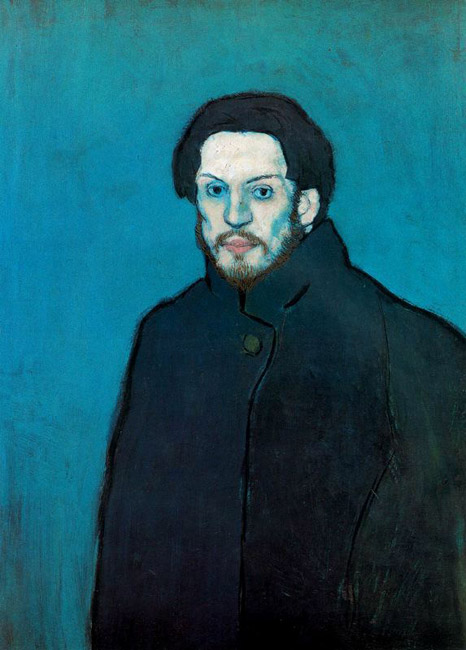
As for Spain, the example of Picasso will suffice. His success is precisely due to the fact that he is Spanish, a lifetime spent in France notwithstanding. John Berger, in his masterly exposition of Picasso in The Success and Failure of Picasso hits on this very point: Picasso being a “vertical invader” of the European stage from the trapdoor that was Barcelona:
Poverty is not surprising to any Spaniard. But the poverty Picasso witnessed in Paris was of a different kind. In the Paris self-portrait of 1901 we see the face of a man who not only is cold and hasn’t eaten much, but who is also silent and to whom nobody talks.


Nor is this loneliness just a question of being a foreigner. It is fundamental to the poverty of outcasts in a modern city. It is the subjective feeling in the victim that corresponds exactly to the objective and absolute ruthlessness that surrounds him. This is not poverty as a result of primitive conditions. This is poverty as the result of man-made laws; poverty which, legally accepted, must be dismissed from the mind as unworthy of any consideration.


Many peasants in Andalusia must have been hungrier than the couple at the table in the etching of The Frugal Meal. But no couple would have been so demonized, no couple would have felt themselves to be so worthless.
Hungary is not Europe. As a part of the Austro-Hungarian Empire, it came in touch with the European core and was set on its way to Capitalism. It is all there in Musil’s masterpiece, The Man Without Qualities. He describes a country in which “there was some show of luxury, but by no means as in such overrefined ways as the French. People went in for sport, but not as fanatically as the English. Ruinous sums of money were spent on the army, but only just enough to secure its position as the second-weakest among the great powers.”

WWI aborted the transformation and later, under socialism, semi-feudal relations survived. Socialism did not destroy them with the vehemence that capitalism would have. You can see that in the beautiful novels of Sandor Marai, in Casanova in Bolzano or Embers.

In Embers, a man’s sense of honor prevents him from opening the diary of his long-dead wife, although it would answer a question which has been tormenting him for 40 years.

Imagine Rupert Murdoch – the hacker of dead schoolgirls’ cell phones – being restrained by a sense of honor. Or Tony ‘Yo’ Blair. Or David Cameron. Sarkozy. Berlusconi.

Berlusconi!

I am not talking about the leaders and outstanding citizens only. Western European writers in general could not think of the idea of leaving a dead wife’s diary unopened. Nor would their readers believe such a plot; it would make no sense to them. That is because sense of honor is not only internal, but also external: it springs from a concern and respect for the others. It is ultimately the recognition of others as one’s equals. A “rational” Western man who is conditioned to view maximizing one’s profit at the expense of others as the natural order of the universe would reject that equality even if his life depended on it.

It is in that sense that Hungary is not Europe: a strong sense of honor is still conceivable there.

And Greece is not Europe. Greece most definitely is not Europe.

Geographically, Greece is attached to Turkey. It was a part of Turkey for 400 years. But it is not geography alone; if Turkey could qualify as a North Atlantic country in NATO, then Greece could qualify as a European country. I am talking about economic and social relations.

In both respects, Greece is closer to Turkey and Iran than France and Germany. The commonality goes beyond baklava and stuffed grape leaves. It pertains to the balance of power between business and the government from which, ultimately, the country’s social relations and the tempo of its daily life originates. You can see that in the disorganization of the social institutions perfectly reflected in traffic. It is the hallmark of a society which has not internalized the discipline of the assembly line – or the call centers, as the case may be.

Because business – Capitalism – in Greece is relatively underdeveloped, the government has assumed the economic functions that in more developed economies are left to the businesses. That further accentuates the relaxed mood of the country and acts as a brake against the “entrepreneurial drive” that is so evident in the West and, especially, in the U.S.

Until the new reforms kicked in, for example, the Greek government paid the full pension of deceased pensioners to the surviving spouse. And if the couple had children under 18, they too, were paid until they turned 18. Turkey and Iran have similar laws.

To the advocates of family values in the West, that is a scandal, a paternalistic restraining of the free people’s spirit which had to change if Greece was going to join the ranks of civilized nations.

That is precisely what the EU and euro are all about. The issue is not the core countries. They are already European. The plan is make the periphery core. Why? Because in less developed periphery countries labor is cheap. Given a common currency, the core countries can exploit that advantage to raise the rate of return of capital.

For that to happen, the government in the periphery countries must get out of the way and make room for business – after making the conditions right for the business to come in.

That is what the racist professor whom I quoted in Part I was saying about Greece. Let us hear him one more time:
A European country without a land registry, without proper tax enforcement and without a responsible political process to control spending and borrowing needs all the outside pressure it can get to increase state capacity ... Pressure to improve state capacity and become a grown-up country is what Germany and European Union are currently providing, free of charge.
Exactly. The Greek government must establish a land registry so that property rights could be unquestionably asserted. It must establish proper tax collection to enforce tax payment from small businesses and the middle class and, most important of all, reign in the spending. What a scandal, paying for the living expenses of a child just because his parents are dead.

This is what has been happening in all periphery countries.

As for the governments getting out of the way, they have no alternatives. Just listen to Jacob Funk Kierkegaard, at the Peterson Institute of International Economics in Washington. He was quoted in the Financial Times of July 22:
Absent a dramatic improvement in the business climate or Greece raising money by selling off its islands, I still think it is going to be a struggle to get investors to have confidence in Greece with such a high level of debt burden.
Greece raising money by selling its islands!

But I am getting ahead of myself.

Friday, July 15, 2011

... And Conforms to the Theory

In the same article, there was this:
Increasingly, they [HFT firms] are investing in technology that enables them to to try to predict where markets will move. Cameron Smith, general counsel at Quantlab, a proprietary trading firm says: “The reality is you need to have some sort of model that sees something that other don't”.
You have heard ad nauseam how technology revolutionized finance. The statement is repeated so often that it is now an article of faith.

But that is getting the cause and effect exactly backwards. It was finance, in the form of speculative capital that, in search of profits, revolutionized technology. I had a front row seat to the revolution in the early 1980s, being paid exorbitant sums to develop trading systems. Cause and effect was there for everyone willing to look.

Capital has no reason to move from one place to another without the possibility of realizing a profit. Long before there was any trading system, there was Western Union. In the U.S., you could send money anywhere in the country in 15 minutes. If you are over 40, you probably remember the ads.

But there must a be a reason for sending $10,000,000 from New York to say, Boston. Without it, the exercise borders on madness.

When speculative capital rises and discovers the arbitrage opportunities in different locations then — and only then — does the need arise for “getting there” fast before the others. Hence, capital is poured in and technology is revolutionized.

In Critique of Dialectical Reasoning, Jean Paul Sartre asks: “Are there regions of reality where [dialectics] is the norm?”. He does not answer the question. My answer is, Yes Mr. Sartre, the realm of economics/finance is one such region. Observe:

Having destroyed the arbitrage opportunities on sight, speculative capital fancies that it can somehow “replace” them with sheer speed; it moves to substitute the speed for arbitrage opportunities. Hence the rise of HFT.

But that is a fantasy. It is the finance equivalent of fancying that you can generate profits without production. So, back to square one and the need for something that could detect a profit opportunity.

But the point that we are in now, looking for a model, is not the same point we were in during the 1980s, looking for a model. That phase created the quants, hedge funds and derivatives.

Today, quants are discredited, hedge funds are institutionalized and derivatives are the indispensable part of the capital markets landscape.

That is dialectics par excellence. A better example of “immediate” going out of itself, becoming “intermediate” and returning to become “immediate” again, but on a qualitatively different level, could not be found.

Come to think of it, I know things about options and options trading that are not common knowledge; if you have read Vol. 3 you know what I mean. Maybe I should take up again what I left decades ago. Imagine a predictive engine for the HFT guys. Imagine the potential. Imagine the riches!

The Contour Becomes Visible ...

I formulated the Theory of Speculative Capital in 1998. An Internet search — I think even Google was around then — registered zero hits for the phrase “speculative capital”. There were several “speculative capital flows”, in which the flows were described as speculative, but nothing for speculative capital as a noun.

The gist of the theory is that speculative capital is a self-destructive force which rises to dominate the financial markets and, in doing so, sows the seeds of their destruction. If you get that, you too, could be a man with a crystal ball.
 
Like all forces, speculative capital assumes many forms; hedge funds (organizational/legal form), derivatives(functional form) and, lately, capital engaged in high-frequency trading, are its various manifestations.  If you read the 9-part series on the subject, you know how this latest form came about.

Each new form of speculative capital is more aggressive and thus, more intense and extreme than the previous forms. It has to be: with the low hanging fruits taken, only the progressively more difficult-to-spot-and-exploit opportunities remain. Gradually, the tension and the prevalence of tension gets noticed, noticed being a different matter from understood.
 
Today, the Financial Times had a relatively long article on how HFT is “hitting headwinds”. The article’s “pull quote”, presumably the most insightful thought in it, was the comment of a Karim Taleb that: “HFT is cannibalizing itself, since it is driving out the very traders it needs to feed off”.
 
Exactly. But then, either Karim or the paper added that “In response, most traders are already turning to other strategies less dependent on speed.”
 
I am afraid that will not work. Even in strategies less dependent on speed, it is important to get there first. Being first counts for something!

What will happen, I think, is that the strategies less dependent on speed will gradually become more dependent on it until they all become totally dependent on speed, just like the equities markets are now. That is how speculative capital changes the markets and sets them up for destruction: by radically altering their structure, i.e., the way they operate.

A system’s modus operandi, the way it works, is designed around its purpose - what it is for. The two are inseparable. Destroying one destroys the other.

When speculative capital destroys, there is no malice or conspiracy. It is just the way it works, the way it is, which is why the destruction goes not only unrecognized but is applauded as continued advancement towards some financial/economic promised land.

Saturday, July 9, 2011

The Origin of the [crisis in the] European Union – 1: When Tendency Becomes Actuality

A comprehensive analysis of what is taking place in the EU requires a book-length treatise; a blog is not a suitable venue for it. What is more, in Vol. 4, I discuss the subject in some detail. That is why except for a few relatively short posts here and there, I have not written about the events in Europe. Then, last night I read Serge Halimi’s editorial in the July issue of Le Monde Diplomatique.

Halimi is a journalist in the best sense of the word and a competent writer, as befitting the editor of LMD. Let me quote excerpts from the editorial, but I urge you to read the piece in its entirety here:
The economic, and democratic, crisis in Europe raises questions. Why were policies that were bound to fail adopted and applied with exceptional ferocity in Ireland, Spain, Portugal and Greece? Are those responsible for pursuing these policies mad, doubling the dose every time their medicine predictably fails to work? How is it that in a democratic system, the people are forced to accept cuts and austerity simply replace one failed government with another just as dedicated to the same shock treatment? Is there any alternative?

The answer to the first two questions is clear, once we forget the propaganda about the “public interest”, Europe’s “shared values” and being “all in this together”. The policies are rational and on the whole are achieving their objective. But that objective is not to end the economic and financial crisis but to reap its rich rewards.
Halimi correctly observes that what we face is not a “technical and financial debate but a political and social battle”. (Dialectics of finance is dialectics of politics, and vice versa.) He then goes on to explain the reason for the policies that seem to be at once insane and rational, because “indignation is powerless without some understanding of the mechanisms that caused it.”

But he does not go to the heart of the matter, which is the intellectual equivalent of asking for the moon. That is a problem, because some understanding would not do. It could not answer, for example, why draconian policies were applied with “exceptional ferocity” in “Ireland, Spain, Portugal and Greece”?

In fairness, the heart of the matter is technical and can hardly be discussed in an editorial. But it must at least be laid down, because it alone can answer the questions, resolve the contradictions and show the way. That is the power and the empowering effect of theory that I have written about in several place – here and here, for example, which delivers us from the submissive acceptance of events just because they occur. Without it, the powerlessness that Halimi mentions is bound to reign. The “market place” of ideas in democracies sees to that.

In democracies, you see, what often stands in the way of people’s grasp of the issues and renders them powerless is not the death of information but its stupefying plenty. The Greek pensioners, French union organizers, British “Open Europers”, the World Bank bureaucrats, the IMF experts, traders, politicians, college professors, think tankers and ordinary citizens have all opined about the crisis in EU. The opinions are often contradictory; how could traders and union organizers not disagree? That creates the “messiness” of the democracy that Rumsfeld himself cautioned us about.

Messiness muddies the waters. Who is one to believe, especially as everyone seems to be at least partially right? Since everybody is partially right – and thus, partially wrong – maybe what afflicts us transcends the individuals and touches upon something more fundamental like human nature. Yessir, that must be it. Surely it is man who is wicked, as the Good Book says. Just look at the Greeks. They do not work hard, do not pay taxes and retire early. No wonder they are broke. As for the larger crisis in the EU? It is the fault of the European “elites” who came up with the idea.

In this way, the degradation of the life styles of 500 million people in the EU is blamed on themselves.

Examples abound.

Here is one Hans-Joachim Voth, Professor of Economics, Universitat Pompeu Fabra, Barcelona, Spain, writing to the editor of the Financial Times on June 24 to opine about Greece:
A European country without a land registry, without proper tax enforcement and without a responsible political process to control spending and borrowing needs all the outside pressure it can get to increase state capacity. The economic evidence is unambiguous – the larger and more effective a country’s state apparatus, the higher output per capita. Pressure to improve state capacity and become a grown-up country is what Germany and European Union are currently providing, free of charge.
And here is Gideon Rachman, an FT commentator, explaining the cause of the EU crisis in his June 21 column:
It is important to understand that the origins of the current crisis lie precisely in the dream of political union in Europe. For the true believers, currency union was always just a means to that greater end ... Helmut Kohl, the chancellor of Germany in the early 1990s, was so convinced of the need to bind a united Germany into the European Union that he was prepared to press ahead with the euro, in the face of 80 per cent opposition from the German public.

At a seminar in London last week, Joschka Fischer, a former German foreign minister ... was unrepentant in defending this elitist model of politics. He insisted that most important foreign policy decisions in postwar Germany had been made in the teeth of public opposition. “It’s called leadership,” he explained.
Yet, does any of this make sense?

If the economic evidence were “unambiguous” that the larger a country’s state apparatus, the higher its output per capita, would the Republicans in the U.S. and the Tories in the UK consistently, insistently and vehemently push for shrinking the government?

More fundamentally, who are the European elites? What is their common interest? Why would they be interested in uniting a country without a land registry or tax enforcement or a “responsible political process” [sic] with an industrial country like Germany? How could they influence the government to carry out unpopular decision, even in the face of 80% opposition?

As all the issues and controversies pertaining to the crisis in the EU stem from the crisis, they reflect the heart of it and, to that extent, contain an element of truth, no matter how contradictory and even nonsensical. If we reach the heart of the crisis, the contradictions will disappear. Newtonian mechanics offers a good analogy. It shows that the same force that makes an apple fall from a tree is the same force that keeps the moon in orbit. There is no contradiction. It also explains the apparent movement of the heavenly bodies as seen from the earth.

At the heart of the EU crisis is the fall in the rate of profit of capital in Western Europe and the U.S.

Why and how does the rate of profit fall is beyond the subject of this post. You could research it yourself or await the publication of Vol. 4. There, I delve into the subject in some depth.

The point to emphasize is that the fall is real – what philosophers call objective reality. And as the rate of profit is the source of the newly created wealth, its fall means that the amount of the total wealth created in the “developed world” is reduced.

This fall and reduction is the result of a process that originally exists as a mere tendency. In the mid 1970s, after the breakdown of the Bretton Woods regime of fixed exchange rates, the tendency exerted itself forcefully and gradually became a real phenomenon. The process continues to date and is behind all the stories about the U.S. losing its preeminence and economic might that you have been hearing for some time.

The “total wealth” is defined expansively, what is crudely and inaccurately captured in GDP. I will return to this subject later. Here I merely note that total wealth is an altogether different concept from the profit of an individual firm, or even a group of firms, say the ones comprising Fortune 500. Likewise, it has nothing to do with the distribution of wealth. The total wealth created in a country could decrease, but the absolute size of the share of that wealth that goes to a particular segment of society could rise. It is a simple matter of ratios. The overall size of a pizza pie could shrink but the amount of pizza you eat could actually increase if you raid others’ shares.

So, there is no inconsistency in saying that the rate of profit and, with that, the absolute value of the total wealth in the U.S., has fallen and yet, at the same time, the number of the billionaires in the country and their total wealth has increased. This state of affairs can come about if billionaires, when they were mere millionaires, could appropriate proportionately more share of the country’s newly created wealth.

There are many ways that an economic class could appropriate proportionally larger share of the newly created wealth. But they all boil down to paying less and thus, keeping more. In the U.S., this was done at both the public and private level, by pushing for tax cuts and reducing wages.

If you live in the U.S., both are familiar stories. The push for tax cuts led the Proposition 13 in California, which limited property taxes and set the stage for subsequent crises, from the 1994 bankruptcy of Orange County to the current, ongoing one. It also created Ronald Reagan and his “philosophy” which was adopted by both Republican and Democratic parties: constant tax cuts, tax breaks and tax loopholes for businesses and the wealthy, “small government” and “starving the beast”, the latter being code for destroying government agencies by cutting their budget on the grounds of lack of funds because the government revenues were reduced due to tax cuts.

In the U.K., Margaret Thatcher played a similar role.

In the private arena, the wages were reduced – either directly or by not keeping up with inflation. Wage reduction is a twofer. First, you pay less for labor. That is one saving/appropriation. Second, because of low wages, the labors’ productivity rises which further increases your profit. The follows from the definition of productivity, which is the value of output (wealth) created by unit labor (measured by the wages).

Here is not so much the proof – as proof only belittles the obvious – but everything you need to know on the subject, from the Financial Times of April 21, 2010, under the heading Biden urges actions on stagnant wages:
Mr Biden, who is in charge of Barack Obama’s “middle class task force” said the last US economic cycle, which began in 2001 and ended in 2007, was the first in history that left median incomes where they were at the start.

Yet, over the same period, the growth in productivity, which had traditionally fed through into wage growth, hit record levels … Mr Biden admitted that the administration did not yet have clear answers on how to address what many economists believe is a long-term structural problem in the US economy.
Note the “long-term structural problems in the US economy” which economists concede and for which Vice President Biden admits he has no clear answer. It is the diminished rate of profit and thus, wealth. It could only be remedied at the expense of sacrificing efficiency, which is another way of saying that it would not happen.

Also, Biden’s reference to 2001-07 period is strictly contextual; he happened to be talking about that specific period. The wage stagnation goes back to the mid 1970s. Financial Times, June 28, 2011:
Fork-lift truck drivers in Britain could expect to earn £19,068 in 2010, about 5 per cent lower than in 1978, after adjusting for inflation. Median male real US earnings have not risen since 1975.
The wage cuts in the U.S. were especially savage. They could not be replicated in Europe with its tradition of strong labor unions. What would you do if you were “European” capital and wanted to increase your share of wealth in the face of falling rate of profit?

What would you do if you had to build a riverfront property and there was no more land?

Why, you would “claim” land from the river. You would dig the mud and sand from the river bed and add to the river bank to create new riverfront land. Ask any major New York developer.

Similarly, if you wanted to bring wages down in Germany, for example, you would bring in cheap labor, non-union labor, Turkish labor.

But there was always a limit to that importation. Not all Germans could be replaced by Turks in German factories.

Could something more fundamental be done, then?

Yes, one could create the European Union. Its main purpose? To inject cheap labor from less developed countries into the Union so that the wealth of the more developed ones could somewhat be maintained.

That’s the EU in a nutshell.