Sunday, February 22, 2009

Palan-doozan at the Helm

In Farsi, palan–with two long ‘a’s, like the French pronunciation of Sagan – is the saddle for donkeys. Saddle for horses is zeen. Zeen is a noble product, made of leather by skilled craftsmen. Palan is made of cloth and, being exclusively for donkeys, does not require much skill. In fact, you don’t really make palan. You sew it, stitch it from rough cloth. That is the job of a palan-dooz (plural: palan-doozan), someone who stitches palan. It is the lowest of the specialized jobs, just one notch above the unskilled laborer.

In Divan-e Shams, Rumi asks the rhetorical question: What does a palan-dooz do wherever he goes? Why, he stitches palan; that is all he knows.

Geithner is now at the Treasury. The New York Times described his plan for rescuing a banking and financial system that is brought to its knees by the over-supply of junk securities purchased with 95% financing at low interest rates:
The Treasury Department and the Federal Reserve plan to spend as much as $1 trillion to provide low-cost loans and guarantees to hedge funds and private equity firms that buy securities backed by consumer and business loans.

Under the program, the Fed will lend to investors who acquire new securities backed by auto loans, credit card balances, student loans and small-business loans at rates ranging from roughly 1.5 percent to 3 percent.

Depending on the type of security they are borrowing against, investors will be able to borrow 84 percent to 95 percent of the face value of the bonds. Investors would not be liable for any losses beyond [their] equity.
So the game that brought down the house is slated go on, only that now the U.S. government will provide the borrowed funds, thanks to its printing press. (Keep in mind that the $1 trillion mentioned is only for starters.) What that would do the position of the dollar as the reserve currency and, from there, to the U.S. power and international standing, will be slow in coming but it will come with the inevitability of night coming after the day.

Recently, Prime Minster Erdogn of Turkey told his critics who were pushing for what he considered a rash decision: “Dear friends, we are not running a grocery store here; we are running the Turkish Republic.”

That distinction is lost on Bob Rubin and his disciples. In his days, he ran the Treasury like a hedge fund. His disciples, including the “brilliant” Larry Summers, think of it as a private equity fund. That sets the direction and limitation of any solution they devise.

The most outstanding feature of the systemic risk brought about by speculative capital – what constitutes risk – is that it narrows the range of the activities within the system at the same time that it excludes the consideration of solutions from the “outside”. A vague realization of this destructive tendency is behind looking for the solutions “outside the box”. More than any revelation, though, the corporate catechism is the confirmation of the limitations within which the system must operate – until it no longer can.

Sunday, February 15, 2009

Indices Gone Wild

Here is a news story from the Feb 12 Financial Times about the West Texas Intermediate no longer being a reliable measure of oil prices:
The global market’s most important pricing benchmark, the West Texas Intermediate crude contract, was criticised yesterday for “sending mixed and misleading price signals, not only to the market but to economic forecasters, government officials and policymakers”.

The International Energy Agency warned that “deterioration in the fragile WTI pricing mechanism would only serve to reinforce the view that the crude has become an irrevocably broken benchmark”. The damning verdict on the WTI contract, which is traded on the New York Mercantile Exchange, by the energy watchdog of the developed world reflects concern among analysts, traders and investors in commodity indices.

Mike Witter, global head of oil research at Société Générale, said: “Brent is more representative of the global market right now and the disconnect between WTI and Brent is an issue.”
Here is a news story in the same paper from October of last year about Libor not being a reliable measure of interbank lending:
The British Bankers’ Association has opened the door to “evolutionary change” in how it calculates London Interbank Offered Rate – Libor – in response to growing criticism about the accuracy of the global benchmark for borrowing costs …

However, bankers fear the index has become distorted in recent months, particularly in dollar markets, because it is calculated according to the bank’s perceived funding costs rather than actual trades. As a result, some bankers are calling for greater use of indices derived from actual market trades.
You see the similarities, including the wording that puts the blame for misbehaving and misleading the public on the index.

Indices, by definition, reflect the markets; only the markets they are reflecting now are the markets of crisis. One of the characteristics of a speculative capital induced crisis is the destruction of arbitrage relations, so that it is not possible to hedge the positions. That impossibility appears as a “disconnect”, by which traders mean that they could not make risk-free profit from differences that finance theorist had insisted had to be arbitrageable.

In the case of Libor, we saw what the disconnect entailed. Libor stood more than 200 basis points over the Fed Funds for months. In theory, a bank could borrow at the Fed Funds rate of 50 basis points and lend it in the interbank market at 2.50% for an easy profit of 2%. But no bank could do it because: i) their credit lines at the Fed were maxed out and they had no acceptable collateral; ii) whatever sums they could borrow were immediately needed; and iii) they did not trust the counterparty bank to stay solvent.

We shall see in coming weeks what the disconnect in the oil market entails.

All this, too, is a part of the destruction about which I wrote earlier, here and here.

Tuesday, February 10, 2009

A Change in the Order

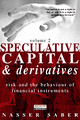
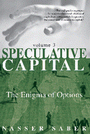
Since early January, I have been working on Vols. 4 and 5 of Speculative Capital, putting hundreds of pages of disjointed writings into a recognizable manuscript form. This is the most time-consuming part of writing a book for me, where the broad outline of the book, the title and order of the chapters, takes shape. The process involves incorporating hundreds of “notes to myself”, references to books and newspaper articles and random thoughts jotted down over the years into a coherent ensemble with well-defined chapters. The last part is especially challenging because many thoughts, at times expressed in tens of consecutive pages, could be placed under different headings with equal justification. It requires long, concentrated hours to determine the chapter headings and the text that should come under it.(It is said of Andrew Lloyd Webber’s music that the scores in all his musicals are interchangeable. I would take no offense at similar charge pertaining to the text in Speculative Capital and would in fact welcome it as a sign of the coherence of the theory; the entire Speculative Capital series is logically but one book.) Dialectics precludes arbitrariness. Each chapter of Speculative Capital must logically lead to the next. It is the progression of these “means” in the dialectical method that is precisely the end. (It was the enforcing of this logical progression a decade ago in a book supposed to be on derivatives that led to the Theory of Speculative Capital.)

I bring up this background because in streamlining the manuscript of Vols. 4 and 5 I realized that their order was wrong. Systemic Risk, planned as the final Vol. 5, must come before Dialectics of Finance, currently slated to be Vol. 4. Therefore, the next book in the Speculative Capital series will be Systemic Risk. It will be followed by the 5th and final Vol., Dialectics of Finance.

Before settling on the decision, I had to convince myself that it was not influenced by the “opportunism” of rushing a book on systemic risk to market in the midst of a systemic crisis, however unconscious and subliminal that influence might be. This was especially pertinent because Systemic Risk could be completed and published sooner than Dialectics of Finance. But I think that my decision was independent of these considerations.

Systemic collapse is an historical event created from the self-destructive movements of speculative capital, the latest and most developed form of finance capital. The development of finance capital is the subject of Dialectics of Finance, which subject “contains” the systemic risk.

The Theory of Speculative Capital helps us see and understand the mechanical aspects of the current crisis. In the 10-part Credit Woes series and several other entries in this blog I have broadly described the various dimensions of the collapse. Vol. 4 will provide further details.

But what explains the price fall – collapse is really the word – across all markets? Why did the prices collapse?

Those with monopoly on high quality thoughts who monopolize the Op-Ed pages and the TV air time inform us that the reason is Bubble. Bubble explains everything. The economy has bubbles as the water has, they tell us. And economic Bubble has popped. That is the answer.

In reality, the price collapse we are witnessing is due to the transformation of values to prices. You do not hear about this topic because it is difficult!

Say, you pay $200k for land, spend $200k on the material and pay $200k for workers to build you a house. The value of the house is $600k. The offer you get, in line with the market price, is $420. The “whereabouts” of the $180k loss is the subject of this transformation, which takes us to realm of value – the exchange value, to be exact. The value is a social concept. Like other social concepts such as honor or morality, it has no meaning to man on a desert island. To understand value, then, we have to go beyond the technical description of the financial events and study the social relations as well. That is precisely the realm of Dialectics of Finance, where the movement of finance capital is investigated in the entirety of its social interconnections. The works of writers of our time, the philosophers of our time and the justices of our time are thus relevant to our investigation.

When I began the Speculative Capital series more than a decade ago, the collapse of the financial markets seemed its logical end, the terminal point for the self-destructive movements of speculative capital. What else could there be after the system-wide collapse of the financial institutions?

But that view is mechanical because it sets an arbitrary ending point for the investigation. A systemic collapse, of however unprecedented scope and intensity, does not spell the end of finance capital. It merely begins a new phase for it. Speculative capital is self destructive, but it is also self reinvigorating and self reconstructing. (Such is the nature of dialectical attributes!) After each crisis, it rises again in a new form to declare: En ma fin est mon commencement. No serious student of finance could ignore these developments.
Truth, the cognition of which is the business of philosophy, became in the hands of Hegel no longer an aggregate of finished dogmatic statements which, once discovered, had merely to be learned by heart. Truth lay now in the process of cognition itself, in the long historical development of science, which mounts from lower to even higher levels of knowledge without ever reaching, by discovering so-called absolute Truth, a point at which it can proceed no further, and where it would have nothing more to do but to fold its hands and admire the absolute Truth to which it had attained.
I would not be finished after the delivery of Systemic Risk. I have barely begun to write.

Thursday, January 29, 2009

A Writer of Our Time

John Updike died at the age of 76. The newspapers were full of laudatory obituaries. He was described as “kaleidoscopically gifted”, “intuitive” and “lyrical”. Mostly though, he was remembered as a “chronicler of the American middle class,” a writer who wrote about the Average Joe.

Chekhov, too, wrote about the average man, about the art students, civil servants, workers.

Chekhov’s “average man” stands for mankind. By tackling the concrete problem of individuals, Chekhov addressed larger issues facing men everywhere. That is what Sarte called littérature engagée or committed literature. Vladimir Kataev describes some of it characteristics in his competent Chekhov critique, If Only We Could Know!
The point at which other writers would think they had completed their task – by making the hero break or intend to break with the social milieu, or by registering their protest against vulgarity and their support for humanity, culture, dignity and personal independence – is the very point at which the real problem and investigation begins for Chekhov.

Truth in Chekhov is above all a synonym for complexity. And most often the Chekhov hero does not know the whole truth.

For Chekhov, an essential component of truth in all its completeness is always beauty.

A further requirement of the “real truth” is that it should be universally significant.

Finally, truth for Chekhov is inseparable from fairness.
Chekhov is a Western writer because his ideas and discoveries are in line with the artistic/philosophical discoveries of the Western artists and philosophers. In his Philosophy of Ethics, for example, Kant shows that the defining characteristics of ethics must be its universality. What is ethical on your part cannot be unethical on the part of your enemy.

For Updike, writing about the average American in the suburbs meant, as the Financial Times correctly stated, writing about “sex, marriage, divorce, materialism”. Salman Rushdie equally accurately said that Updike wrote about “wife swapping in the suburbs”.

Updike’s average man has no social significance; the author could not discern the social issues the way he “discerned” the smell of a barn in a New England village. This provincialism was in full display whenever he took on what the New York Times called the “exotic” subjects. The “Coup”, “Brazil” and “Terrorist” were downright embarrassing.

Updike, too, was part of the milieu in which the current financial crisis is unfolding.

Wednesday, January 28, 2009

Mr. Geithner Issues a Directive

The most telling news of the day was Treasury secretary Geithner’s promise to curb the banks’ lobbying for bailout money. “Geithner Limits Lobbying for Bailout Money”, The New York Times informed its readers.

Recall that in October then Treasury secretary Paulson forced the CEOs of the banks to accept the bailout money. The Times reported:
The chief executives of the nine largest banks in the United States trooped into a gilded conference room at the Treasury Department at 3 p.m. Monday. To their astonishment, they were each handed a one-page document that said they agreed to sell shares to the government, then Treasury Secretary Henry M. Paulson Jr. said they must sign it before they left.
That was then.

Now the banks are lobbying for the money. Ordinarily, you would think that the bailout money would go to banks in need of capital; emergency help goes to those who need it. Ordinarily, the Treasury should easily determine which banks need the money. That should leave no room for influence peddling. But these are no ordinary times.

That in a mere 90 days the money earmarked for saving the U.S. financial system has turned into potential loot and the Treasury has to issue directives to protect it speaks volumes about the milieu in which the financial crisis is unfolding.

Tuesday, January 27, 2009

The Subject Matter of Finance

Among the mainstream press, FT’s Lex column offers one of the more consistently thoughtful business observations. This past Friday’s column noted that after the firing of “Mr. Fix-It” from BofA and the hiring of Parsons as the Citi chairman – both considered good news for very different reasons – the stock of both companies dropped. From this evidence, the paper concluded:
The truth is that coming and (popular) goings of bank executives are a side-show. The financial crisis is not discriminating on the basis of management quality. The economic forces unleashed by financial crisis are so powerful that leaders have to a great extent been reduced to mere spectators.
In this backhanded way, and thanks to an unprecedented crisis, the FT finally recognized what the readers of this blog have always known, that the subject matter of finance is not people. It is capital in circulation.

There is more.

Financial crises that befall a financial system do not come from without. They are created from within the system, from its internal developments. Far from being aberrations, these crises are the natural stages – different moments, to use a term from mechanics – of a system whose functioning requires and produces a state of unstable equilibrium.

The process is not mechanical and depends on the actions of “market participants”. The executive officers of financial institutions, in particular, play a critical role in it by virtue of the exercise of their powers that influence the events. They acquire, divest, hire, fire en masse, grant favors and dictate the legislation. In the current crisis, they have been in the hyperactive mode, working feverishly to influence the events to their liking.

Yet, to the observant Lex writer they seem as spectators. What gives?

The answer is that the human actions are the very cause and source of the crisis. Who, but these very same executives and their counterparts in investment funds and trading rooms, brought about the current crisis? The most critical point, however – the point that separates the Theory of Speculative Capital from the simple narratives of the crisis – is that people do not act in vacuum. Within the modern financial market, in particular, they act under conditions created by speculative capital and in line with its dynamics. In doing so, they become the agents of speculative capital, a force that guides their actions but remains hidden from them.

Speculative capital is self destructive; it tends to eliminate the opportunities that give rise to it. This tendency manifests itself in many and varied ways, from the simplest, most obvious pruning of “excess spreads” between two European government bonds to the most spectacularly indirect. Lehman bankruptcy was an example of the latter.

The agents of the speculative capital follow the same self-destructive course, which is why their actions ultimately become self-defeating. Under such conditions, it does not matter which executive is in charge, a fact that the “market” eventually recognizes and reflects in a company’s stock price. But this happens not because managers are passive spectators. It happens because they are active agents. This process goes on at all times but it is more transparent at times of crisis.

The interaction of humans and markets is ultimately the interaction of the thinking and being. That is what this blog explores via its commentaries. A systematic exposition of the subject must await the publication of Dialectics of Finance.

Wednesday, January 21, 2009

Why Was Lehman Allowed to Fail?

The question of why Lehman was allowed to fail had preoccupied me ever since the news reached me while on vacation.

That Lehman’s was the largest bankruptcy ever – with about $630 billion in assets – did not tell the full story. Lehman was a major prime broker and one of the largest players in the commercial paper market. Its notes were widely held by institutions of all stripes and there was a large and active credit default swap market linked to the company’s name. Additionally, the firm’s broker-dealer arm financed well over $100 billion a day in the tri-party market. These activities directly linked the firm to all the major banks, broker-dealers, pension funds, hedge funds, mutual funds and money market funds, to say nothing of thousand of small and medium size firms and municipalities. A place such as Lehman could not gently go into that good night even if it wanted to.

And it did not. On the news of Lehman’s bankruptcy on Monday, September 15, the short-term repo, interbank lending and CP markets froze. By mid-October, the crisis had spread to all parts of the credit markets in the U.S., the Western “liberal democracies” and many emerging markets. One could argue that a substantial portion of $9 trillion in commitments that the Fed and the Treasury have pledged to “calm” the markets in the past three months is the cost of the Lehman failure.

The decision to let Lehman go under is now universally recognized as an epic blunder. In an uncharacteristically harsh editorial, The New York Times called for grilling Geithner in his upcoming confirmation hearings for his role in Lehman’s bankruptcy. The editorial pointed to the shifting explanations of the Treasury and the Fed as evidence that the true story had yet to be told. Indeed, save for Paulson’s shifting explanations – first, “we had no business saving Lehman”, and then, as things got hairy, “we had no authority to save Lehman” – no explanation is given for the fateful decision. Presumably, only Paulson, Bernanke and Geithner know the answer – and they are not talking.

Or do they?

In Othello, Shakespeare reaches to the intellectual dominance of the man in man-beast relation to give us the visually compelling metaphor “being led by the nose”, making someone do something that he would otherwise not do.

The Moor is of a free and open nature,
That thinks men honest that but seem to be so,
And will as tenderly be led by the nose
As asses are.
I, too, was led by a faulty conviction to saying and writing things that I would otherwise not say and write. Here is what I wrote upon hearing the news:

It is inconceivable that the Fed would force a major broker dealer ... into bankruptcy for the sake of making an ideological point. The Lehman failure is a defeat, a setback. The Fed would have done everything within its power to save the firm. That it did not, because it could not, is the central story behind Lehman’s failure. In the Lehman crisis, the Federal Reserve reached the limits of its omnipotence. It was rendered impotent because it did not have the financial wherewithal to intervene.
The passage is on the mark on its fundamental premise: that Lehman’s bankruptcy would become an event to remember and that it was a defeat for the Fed. But look at the unbridled faith in authority: “It is inconceivable that the Fed would force a major broker dealer into bankruptcy for the sake of making an ideological point.” The day I wrote this must have been my salad day, when I was green in judgment.

Or take the comment about the Fed’s lack of “wherewith”. It, too, was technically accurate. But if it only were true that the Fed would be restrained by legal constraints!

One learns. With what has come to light in the past couple of months, I can now surmise why Lehman was pushed over the cliff. As always, characters and incidental events matter, but they play out against a backdrop set by finance capital and the dynamics of its latest, most developed form, speculative capital.

Most immediately, Lehman was allowed to fail because no one in the position to save it understood the consequences of the failure as they unfolded. The haphazard response of both, the Treasury and the Fed, to the unfolding events – one observer characterized it as a ”Whack-A-Mole” approach – provided ample proof of that. I also wrote a long piece here , explaining why despite having detailed knowledge of technicalities, the officials did not understand the situation.

The incidentals played a role as well. Lehman’s broker-dealer arm was organized as a separate legal entity, an obvious “strategic” decision that, whatever original purpose or merits it might have had, ultimately contributed to the undoing of the firm. As a separate entity, the BD could be kept out of the bankruptcy proceeding, as indeed it was. The consideration of that scenario must have added to the bravado of the decision makers at the Fed and the Treasury, leading them to believe that with the critical BD out of the way, they could handle the post-bankruptcy situation. (On the very same day September 15, the Fed guaranteed about $90 billion of trades for the LBI New York trades, Lehman’s broker-dealer subsidiary.)

But why the bravado? Even if Paulson, Bernanke and Geithner did not understand the consequences of Lehman’s failure, why the cavalier attitude ?
This summer, as he fought for the survival of Lehman Brothers, Richard S. Fuld Jr., its chief executive, made a final plea to regulators to turn his investment bank into a bank holding company, which would allow it to receive constant access to federal funding. Timothy F. Geithner, the president of the Federal Reserve Bank of New York, told him no, according to a former Lehman executive … One week later, Goldman and Morgan Stanley were designated bank holding companies.

This claim that Fuld also repeated under oath in front of a Congressional panel was never denied. The question then arises: Why the intransigence, this uncompromising stand, under clearly risky circumstances from an institution with born-in bias to err on the side of caution?

The answer has to do with the machismo that, as a byproduct of the rise of speculative capital, has infested the financial culture in the West and particularly in the U.S.

At the root of this machismo stands the need to be “unpredictable”. The financiers of bygone eras who thought of themselves as gentlemen bankers would have taken offense at such characterizations. But with the rise of short-term trading driven by speculative capital, unpredictability, like being foul-mouthed, became a virtue. The latter meant to project an image of toughness in a business that was considered cut-throat. The former was fashioned after the conduct of gamblers; it was a virtue in the sense that the rivals could not "read" one's hand and, by extension, the next move. Both were the logical results of a system that promoted every-man-for-himself profit maximization.

I pointed to this mindset in Vol. 1 of Speculative Capital in discussing Robert Rubin’s conduct as a Treasury secretary. I looked at a case where he “ambushed” the currency markets to drive up the dollar against the yen and wrote: “So the Treasury secretary of the United States fixes the exchange rate of the dollar against the yen by sowing uncertainty about their exchange rate!”

It is perhaps worth commenting that one of the birth places of this traders' culture was Lehman. Ken Auletta’s Greed and Glory on Wall Street is a readable chronicle of the takeover of the control of Lehman Brothers by “traders” who pushed aside the "gentlemanly" investment bankers in 1984. The palace coup was led by the head of trading, Lew Glucksman. Auletta describes him:
Glucksman usually worked in a glass-walled office ... where his people could see him, feel his presence ... hear him bellow profanities ... watch his round face redden with rage, see him burst the buttons on his shirt or heave something in frustration, watch him suddenly hug or kiss employees to express appreciation ... He sometimes rewarded or terminated employees whimsically ... Employees fondly remember how would pause and laughingly instruct them how to use words like gelt or shmuck ... His legendary temper was carefully cultivated.
The “bad boy/tough guy” conduct, with the unpredictability that went with it, soon became the currency of the trading room and, from there, turned into an attribute of leadership. All office boys with executive ambitions wanted to be unpredictable and able to surprise.

In light of everyone’s expecting Lehman to be saved, letting it go down must have been seen as the ultimate sign of unpredictably, a tough executive decision under trying circumstances that pointed to leadership qualities.

Still, the decision of such magnitude could not have been made without consultation with the industry. The Times article quoted earlier said as much and then went further:

Mr. Geithner, 47, played a pivotal role in the decision to let Lehman die and to bail out A.I.G. A 20-year public servant, he has never worked in the financial sector. Some analysts say that has left him reliant on Wall Street chiefs to guide his thinking and that Goldman alumni have figured prominently in his ascent.
I have no knowledge that “Goldman alumni” were behind Geithner’s decision to play hardball with Lehman. But what is certain is that they did not intercede on Lehman’s behalf either. Neither did other broker-dealers. Had the “industry” rallied behind Lehman, it could have swayed the Fed’s decision; following a meeting between Geithner and Blankfein, the Fed rushed to bailout A.I.G., a Goldman client.

That brings us to the final piece of the puzzle: why other institutions, especially trading institutions, did not lobby the Fed on Lehman’s behalf given the strong bonds within the industry? While the competition amongst the financial firms for trading and business was always fierce and real, every competitor at the same time was a potential counterparty to a trade. That consideration created a common interest that rose above the local rivalries. This common interest was, and still is, reflected in many professional organizations that lobby and speak on behalf of the “financial industry”. In the case of Lehman, that common interest failed to save the day because it no longer existed.

Blame it all on speculative capital.

Speculative capital, capital engaged in arbitrage, is self-destructive; it eliminates opportunities that give rise to it. As the bid/asked spreads narrow due arbitrage, speculative capital increases its size to partially compensate for the falling profit. But the increase in size puts even greater pressure on the spreads, to a point that it is not possible to make any profit, especially when the leverage ratios are substantially reduced. In the face of a dwindling profit pie, the surest way of protecting one’s share is reducing the number of participants in the market. That simple fact is behind the seemingly high minded recent self-regulatory proposals that were recently announced with fanfare:
Complex securities businesses that once fuelled explosive profit growth on Wall Street and in the City of London would be dramatically limited in scope and size under proposals revealed yesterday by leading banks in response to the credit crisis.

The blueprint would restrict complex financial products to only the most sophisticated investors, tighten oversight of large swathes of the derivatives markets and require banks to spend more on technology and risk management.

The plan – backed by banks including JPMorgan Chase, Merrill Lynch, Citigroup, HSBC, Lehman Brothers and Morgan Stanley – will be presented to US and global regulators considering various ideas for increasing oversight of the credit markets ...

Perhaps the most unexpected proposals by the banks involve new criteria for the “sophisticated investors” allowed to buy complex financial products. Under the plans, even pension funds and other institutional investors would no longer be automatically allowed to buy bonds backed by assets such as subprime mortgages.
It was the natural expansion of speculative capital in search of arbitrage opportunities that created conditions that led to the demise of many financial institutions, including Lehman. Lehman’s case stands out. Other financial institutions could have prevented it but chose to stay on the sidelines because they calculated that Lehman’s demise was their gain. This was a consideration that had never before entered the calculus of the Wall Street – certainly not in relation with a firm of Lehman’s size and stature.

But Lehman was an integral part of the “the Wall Street”. In letting Lehman fail, the Wall Street also took an ax to itself. In a few places, I have written about the self-destructive tendency of speculative capital that manifests itself by the self-destructive action of the financial agents. Lehman’s failure was the most compelling example of that tendency to date.

The subject of the dialectics of finance is studying these self-destructive tendencies which arise naturally, i.e., logically, from the internal developments of the systems.